Off Stage with: Cassady Moll
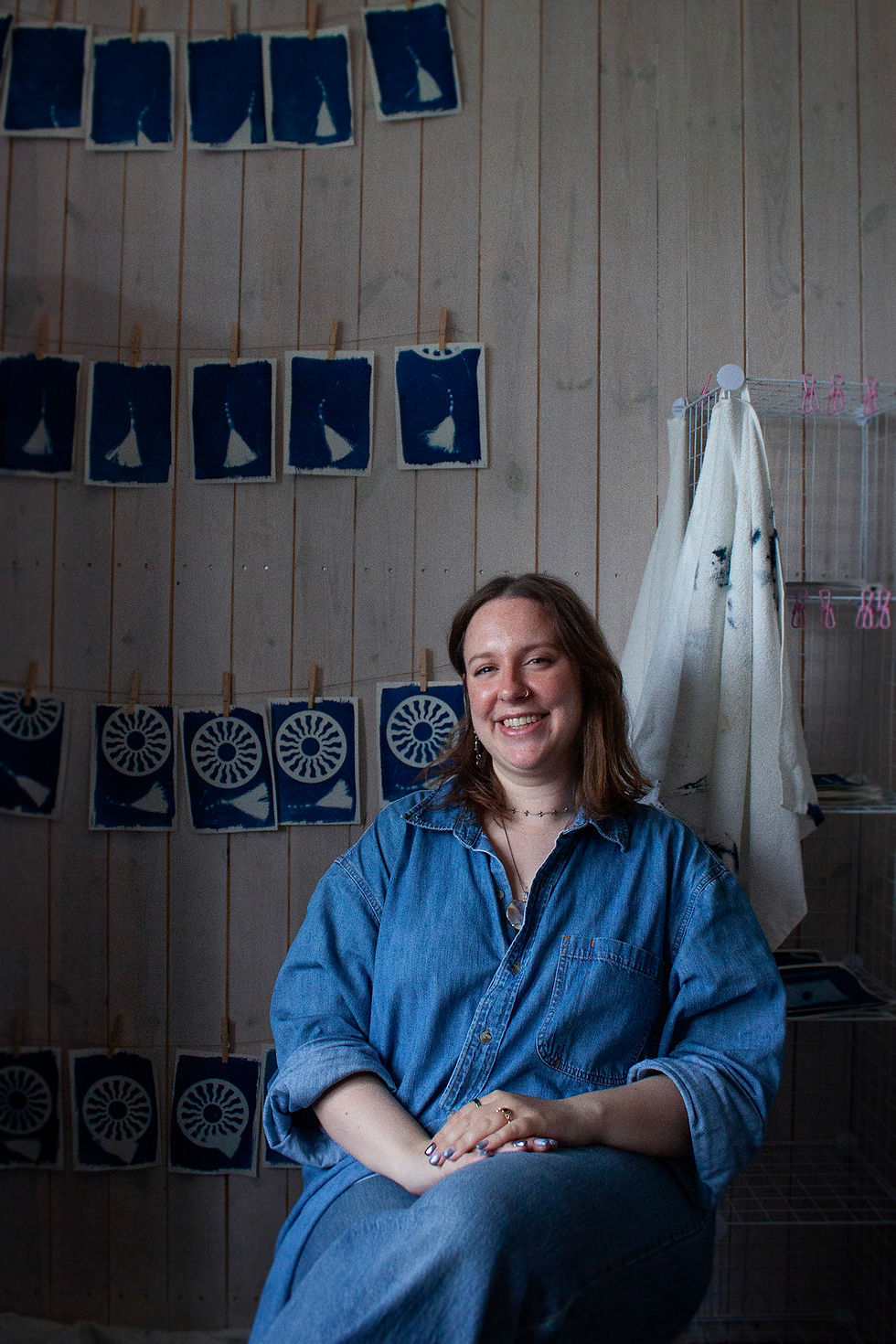
We recently visited printmaker and motion artist Cassady Moll in her studio at Baggerbeest in Amsterdam for a look behind the scenes of her creative work. Her journey started with graphic design jobs in California and has shifted to an artistic practice where a mix of music, long walks, and a dash of boredom takes her work into themes of human connection. We talk process, burnout, and the mysteries of human memory. Oh and we got to try making a cyanotype with her! Let's step off stage into her studio.
Hi Cassady! What is creativity off stage for you?
I think for me it's the little moments of human interaction, or even whimsy that I notice when I'm out and about. Typically this is on my bike ride to the studio, where I pass through a big chunk of Amsterdam. Examples of this could be anything from the Instagram boyfriends taking photos of their girlfriends leaning on the touristy canal bridges, or smaller, subtler moments like a delivery driver on an e-bike stopping to pluck a plant growing on the side of the bike path that he thought was interesting or beautiful (literally saw this last week, and it made my whole morning). My brain tends to work like a database of snapshots, collected over time, maybe to find the beauty in small things, but also as a sort of analysis on how I perceive these moments from my own perspective. I don't actually know why the e-bike rider stopped to pick a flower, or why the Instagram boyfriends chose that specific spot, but I found the moment interesting, so I cataloged it away.
What part of your daily life/creative practice does no one see?
The perhaps very boring but very real answer to this is morning pages, which I picked up on maybe my 3rd attempt of doing the Artist's Way? The rest of the practices admittedly fell to the wayside as life became more busy, but the morning pages have remained. Brain dumps are pretty crucial to my mental clarity, and while I enjoy life's little distractions, sometimes if I don't take the time to dump out all of the minutiae, it becomes overwhelming and clouds my creative process. I think that's a big part of the creative brain that gets talked about less; how we have so many ideas, but without filtering and organizing, they can sometimes lead you on an ambiguous and annoying wild goose chase. I try to at least corral the geese before I get started on a project! (Haha).
Is there anything that is always part of your process? Music, deadlines, chaos, complete silence?
For the beginning / ideation process, going outside, and veeeery long walks without headphones, preferably in a park, sometimes in more urban areas if the mood strikes. Music is wonderful, but I find that it distracts my brain from actually getting bored enough to wander, and the mind wandering is where most of my best ideas come from. I think a lot of creativity is staved off by constant stimulation, so it's a good, if not crucial practice to let yourself become bored. So, initially boredom. Then, once I identify and resonate with an idea, I tend to suss out a general timeline of what I'm trying to accomplish, and stick with it. Hard deadlines with art are a bit sticky (I don't necessarily believe in forcing something if you're having an off day), so I tend to keep it broad-ish with some breathing room of a week or two, like, "I want to get this done by the end of June / first week of July," etc. For production, I'm very pro music, especially when I get into a flow with the frames (I've been making a lot of frame-by-frame animation pieces lately, so once I've sorted the rhythm and storyboard out, those are very bang-it-out, scan, organize moments). This process tends to be my go to, and works well especially if I'm feeling stuck.

What do you never again want to hear, meet, or handle in your creative practice?
Oof! Very good question. My first jobs out of college were very dull, very production-heavy in-house graphic design work for tech companies in the Bay Area in California. If you told me that I never needed to open or even touch an InDesign file again, I would be the happiest woman on Earth. Specifically, an InDesign file that's super slow, 20+ pages with a million unlabeled layers that some poor contractor probably had to smack together in a week, that I then had to clean up and organize. That kind of "creative" work was this wicked combination of very challenging but also boring as all hell. And not the good kind of boring! To be honest, I think it made me realize that I didn't want to be a graphic designer, or even an editorial illustrator, which I also did for a while (and still do off and on, if it fits with my schedule and doesn't distract too much from my studio practice). There are aspects of these jobs that I really enjoyed, but the reality is, I think I'm just not cut out for creative work that I have very little or no say over, or whose theme is predetermined. Once I realized that I really wanted to have a career as an artist, I mostly quit doing creative work for other people as a day job, in order to reserve that energy. I sometimes wish that I could be the type of person who does a creative day job for a company and goes home and works on personal projects, but I'm just not, and I feel like that's important to say for people that are maybe feeling the same way I did. I feel like I have a lot more peace of mind now that 90% of my creativity goes towards my studio and art practice, and I can do what I want with it.


What do you still not fully understand about your creativity?
I think I just don't understand where the urge to create comes from within me. It's like an impulse that I can't help but lean into. If I don't make something for a while, or have a bit of a lull, I feel less like myself. My identity is very strongly tied to the idea of me being a "creative person," so maybe it's a sort of self-fulfilling thing? I'm not sure. I don't feel particularly drawn to like, renown, celebrity, wealth, that kind of thing. I think I just have this urge to make things and share them with people, because I feel most connected to humanity that way. So maybe I do understand it: I don't really feel a need for recognition, but more a need for connection.
What is the most chaotic thing that happened to you(r creativity), and how did you handle it?
A bit before we moved to the Netherlands, I completely burnt out at my last graphic design job in California, that I only had for 4 months. It was a mid-sized startup with a lot of expectations and a lot faster-paced than I was used to, and frankly I don't think I was ready for the amount of work and responsibility that I suddenly had. That combined with a boss who seemed to disapprove of me from the jump, made every hour working there an anxiety-ridden nightmare for me. I was eventually gently let go (or rather, the California version of this, which was: put on Performance Improvement Plan (tm), you must log and monitor your every waking move in a dedicated document that your boss can view at all times, you burn out even more, then eventually you just put in your two week notice because they're probably going to fire you anyway). This really made me question if I even liked the career trajectory that I was on, and the answer, as I touched on earlier, was no. So, even though that experience was horrible, it forced me to think about what I actually wanted to do, and provided me with a sort of escape route to pursue having my own art and printmaking studio.

In a dream scenario, what would your days look like?
I have an established studio and practice that nets me enough money to live off of, so I don't have a need for a day job. I wake up around 9 or 10, and have a slow morning where I leisurely make my coffee and breakfast, take my time getting ready, then head to my studio, where I'm working on an interesting, larger scale dream project that's funded, so I can put all my energy towards it. I work from my studio 4 days a week (5 days only if I'm hosting a printmaking workshop on a Saturday/Sunday), with Wednesday being the weekday I have off (I love a midweek break!). I lose track of time working on the aforementioned larger scale dream project, only stopping when my lunchtime alarm goes off, because I'm having lunch with a friend today. The lunch goes on for as long as we like, then I head back to the studio to finish up any loose ends, probably heading home around 7pm, where I have a nice dinner with my partner. Then we hang out with our cat and watch a show (either something really great, or really trashy that we can laugh at), going to bed whenever we feel tired.
Tell us a little bit about your interest in perception and memory!
I think it does really tie back to my interest in human connection, and how crucial it is to experiencing life, even when it causes dissonance. We could all be at the same event, at the same time, doing the same activity, and still the experiences would differ from person to person, for a variety of reasons. Does this event remind them of another event from their past? Was this event joyful? Isolating? Exciting? Traumatizing? Our memories are deeply personal, but also ephemeral, which means they can be easily rearranged or even completely changed by others' input. So really my practice centers around this idea: because memory is always shifting and changing, coming in and out of focus, what does it mean to capture reality?
How does the physical space you're in affect your creative process?
If I'm in a cluttered space, my mind is cluttered. If I'm in a calm space, my mind is calm.This feels obvious, but I think I need a balance between these two spaces to really get into a flow. Too much clutter, and my brain gets overwhelmed with information and ideas (back to the morning pages!), but if a space is too "clean" (read: empty, minimalist), I feel like there's nothing to spark interest and my mind also goes "clean" or blank. Physical space affects me greatly, so I take a lot of care to curate it to my needs. On days that I need a bit more inspiration, a bit more mess (but curated mess, haha), on days I need to focus, a bit less. My studio is kind of divided into these little zones, some more organized than others, and I'll wheel my chair to a different section, depending on what's needed for that day. This way, if I need organization, I can have it (my desk), and if I need clutter, I also have it (my worktable).

What is one big, audacious dream project you'd like to take on?
I'm really drawn to motion, so I think the big dream project would be a longer-length frame-by-frame animation project (made from either cyanotypes or anthotypes, which I've been getting into more recently). At the moment my pieces loop, and they tend to be anywhere from 5 - 20 seconds long. There is a point to the repetitious, meditative nature of them, but I think eventually I'd like to move on to something with a more complex narrative and structure. This would coincide with the individual frames being displayed alongside it, I think maybe in a separate room, that would lead you to a screening area to view the completed piece. But who knows! In the next year I'm also planning on making some physically larger-scale pieces, so we'll see where that takes me. I feel like ultimately my practice is intuitive, and the physical mediums that inspire me change often, so it's hard to say exactly what form the dream project will come in, but the ethos of exploring memory and its intersection with reality will always remain the central focus.

And with that, we hop on the bike to leave Baggerbeest and Cassady’s studio, inspired by her approach to creating and grateful for the honest peek behind the curtain. If you’d like to see more of Cassady’s work, check out @cassadymoll.studio on instagram. You can even join one of her workshops if you’re in Amsterdam! From experience, we can assure you it'll be a good time.
Comments